Texting has changed the way we communicate, and acronyms like IDT have become part of everyday conversations. But what does IDT really mean?
How should you use it? And when might it be misunderstood? In this article, we’ll explore everything about IDT meaning in text, from its origins to practical usage, professional suitability, and even funny ways to respond.
Whether you’re texting friends, posting on social media, or chatting in gaming forums, this guide has got you covered.
Definition & Meaning of IDT
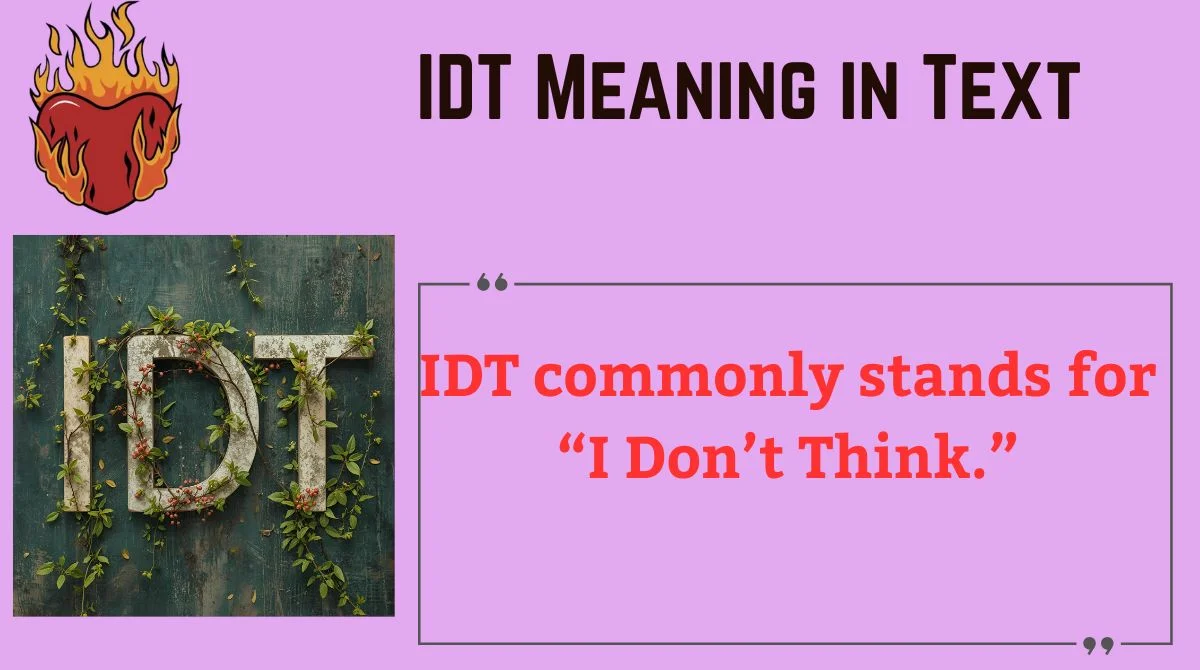
IDT commonly stands for “I Don’t Think.”
It’s often used to express a thought, opinion, or hesitation in a casual, quick way. For example:
“IDT that’s a good idea.”
“I don’t think that movie is worth watching.”
In essence, IDT is just a shorthand for expressing doubt, disagreement, or uncertainty without typing the entire phrase. Its meaning is usually straightforward, but context can subtly change the tone—from casual to sarcastic.
Origin & History of IDT
Texting acronyms like IDT emerged from the rise of SMS texting in the late 1990s and early 2000s. People wanted to communicate quickly with fewer keystrokes. Early online forums, chat rooms, and instant messaging platforms like AOL Instant Messenger (AIM) and Yahoo Messenger encouraged short forms like IDT, IDK, and IMO.
IDT gained traction in social media and gaming communities as communication speed became essential. Unlike some acronyms that evolve into memes, IDT has remained relatively stable in meaning—focused on expressing personal opinion or doubt.
How IDT is Used in Different Contexts
Texting & Messaging
In personal text messages, IDT helps express opinion without seeming confrontational. For instance:
- “IDT he’s going to show up on time.”
- “IDT this is the right solution for our project.”
It’s casual, short, and conveys hesitation politely.
Social Media
On platforms like Twitter, Facebook, or Instagram, IDT is often used in comments to respond quickly. Examples include:
- “IDT anyone will agree with this opinion 😅”
- “IDT that outfit looks good on him.”
Here, tone can be sarcastic, humorous, or neutral depending on the context.
Gaming
In gaming chats, IDT can communicate doubt or disagreement:
- “IDT we should attack now, wait for backup.”
- “IDT that strategy works in ranked matches.”
Gamers often use IDT alongside emojis or GIFs to soften or emphasize their opinion.
Casual Conversations
With voice-to-text apps or casual messaging, IDT can appear spontaneously:
- “IDT this will last long.”
- “IDT she’ll join us today.”
The casual nature of IDT makes it perfect for quick, informal communication.
Common Misconceptions & Clarifications
Even though IDT is simple, people sometimes misinterpret it.
- Confused with IDK – IDK means “I Don’t Know,” whereas IDT means “I Don’t Think.”
- Seen as rude – Some think saying IDT is dismissive. Tone and context are key.
- Assumed formal – IDT is informal; avoid using it in professional emails unless the recipient is a close colleague.
Similar Terms & Alternatives
Here’s a quick comparison of IDT with related acronyms:
| Acronym | Meaning | Difference from IDT |
|---|---|---|
| IDK | I Don’t Know | Expresses uncertainty about knowledge, not opinion |
| IMO | In My Opinion | States personal view, less about doubt |
| I Guess | I guess / uncertain | Similar, but softer and less direct |
| TBH | To Be Honest | Adds honesty emphasis rather than doubt |
Using the right term ensures clarity and prevents confusion.
How to Respond to IDT
Casual Response
- Acknowledge the opinion: “Yeah, you might be right.”
- Offer a counterpoint: “IDT, but I think it could work.”
Funny Response
- Playfully disagree: “IDT, but my magic 8-ball says yes 😂”
- Use sarcasm lightly: “IDT either, and that’s saying something 😎”
Professional Response
- Polite disagreement: “Thanks for sharing. I see it differently because…”
- Neutral acknowledgment: “I understand your view, though I have another perspective.”
Regional or Cultural Differences
IDT is mostly English-speaking in origin, but it can appear in international contexts due to global social media and gaming platforms.
- US & UK: Common in casual chats.
- Other English-speaking countries: Mostly used online, less in formal conversation.
- Non-English speakers: May adopt the acronym in online gaming or texting but not in professional environments.
Understanding these nuances prevents miscommunication across cultures.
Comparison With Similar Terms
| Term | Tone | Usage |
|---|---|---|
| IDT | Neutral, casual | Express doubt or disagreement |
| IDK | Neutral, casual | Express lack of knowledge |
| IMO | Slightly formal | Express personal opinion politely |
| I Guess | Casual, soft | Tentative opinion, less assertive |
This quick table helps you choose the right acronym for the situation.
Usage in Online Communities & Dating Apps
IDT shows up frequently in forums, dating apps, and social communities:
- Reddit: Users often type IDT in comment threads to express opinion without confrontation.
- Discord: Gamers and communities use it to react quickly in chat channels.
- Dating apps: Subtle disagreement or opinion: “IDT that’s a good idea for a date 😅”
Pro tip: When in doubt, read the tone and emojis—they help interpret the intent behind IDT.
Hidden or Offensive Meanings
IDT is generally safe, but context matters:
- Sarcasm or frustration can make it seem dismissive.
- Misreading tone could create offense, especially in sensitive conversations.
Tip: Combine IDT with emojis or follow-up sentences to clarify intent.
Suitability for Professional Communication
IDT is usually informal. In work emails, reports, or LinkedIn messages, it’s better to spell out “I don’t think”:
- ❌ “IDT that’s the best approach.”
- ✅ “I don’t think that approach will work effectively.”
In chat platforms like Slack with colleagues you know well, IDT can be acceptable if used sparingly.
FAQs About IDT Meaning in Text
What does IDT mean in texting?
IDT stands for “I Don’t Think”, used to express opinion or doubt quickly.
Is IDT the same as IDK?
No. IDK means “I Don’t Know”, whereas IDT expresses doubt or opinion.
Can I use IDT in professional messages?
It’s best to avoid IDT in formal emails. Spell it out instead: “I don’t think.”
Where is IDT most commonly used?
IDT is popular in text messages, social media, gaming chats, and casual online communities.
Does IDT have a negative meaning?
Not inherently, but tone can make it seem sarcastic or dismissive in some contexts.
Conclusion
Acronyms like IDT have made digital communication faster and more expressive. Knowing its meaning, usage, and context helps you communicate clearly and avoid misunderstandings. Whether you’re texting friends, gaming online, or commenting on social media, IDT is a handy shorthand—just remember to read the tone, audience, and context carefully.
With this guide, you now have a complete understanding of IDT meaning in text, how to respond, alternatives, and even professional usage tips.

Mark Peter is the creative mind behind RizzleLineLove.com, your go-to hub for witty, flirty, and downright hilarious pick-up lines. With a passion for blending humor and charm, Mark crafts content that sparks conversations, breaks the ice, and adds a playful twist to everyday moments.
Whether you’re looking to impress your crush, make your friends laugh, or spice up your social media captions, his work is all about helping you connect — one clever line at a time.